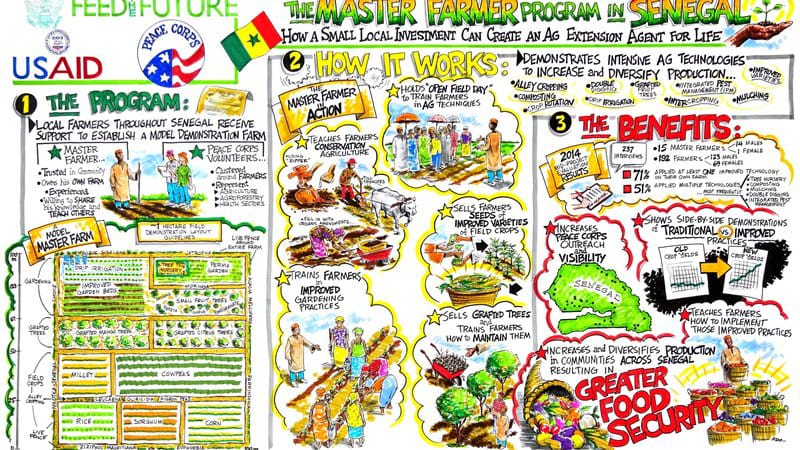
From the day we arrived at our site, one of our work counterparts, Master Farmer Guelode Dia, was itching to host an Open Field Day. His farm, one of more than 40 Master Farms across the country, serves as a demonstration space and training ground for local farmers and gardeners. Bright-eyed and bushy-tailed, we agreed to help facilitate the event. It was a journey that became an invariable rollercoaster of emotional and physical highs and lows, ultimately culminating in an enjoyable day of visiting with the community and talking about dirt.


Master Farmer Program
A path to creating agriculture extension agents for life. At least, I think that’s what the billboard would say.
Started in 2010, in partnership with USAID as part of the Feed the Future initiative, the Master Farmer Program is perhaps the flagship program of Peace Corps Senegal. Based on nominations from volunteers, interviews and staff reviews, model farmers are selected across Senegal to manage a one-hectare demonstration farm.
At the Master Farm we test, demonstrate and adapt the best technologies that Peace Corps has to offer in the domains of field crops, gardening, agroforestry, health and agribusiness. The idea is to create delocalized training centers and sources of seed for local farmers. We aim to show farmers that a well-managed, one-hectare farm can significantly improve food security for their families.


It is increasingly important for farmers in our region to recognize the potential for agriculture to increase their food security and income. A variety of climatic and cultural factors are leading many people away from farming. Many young people in Senegal, especially men, leave their home villages to find work in bigger cities in Senegal and abroad. Those that remain, with few opportunities for work, farm by default, viewing their work as a last resort. Naturally, this results in low investment and little motivation to seek innovative farming technologies. We use the Master Farm to reinforce ideas that we share with farmers in our area and encourage them to adopt practices that are appropriate for our region.
Emilie and I are privileged to live within about a kilometer of one of these farms. Our role with the farm is to serve as a technical resource, encourager and liaison between the Master Farmer and Peace Corps Staff. We are expected to help with goal setting and record keeping. We help plan and facilitate trainings, and we help to organize, plan and implement many of the demonstrations in the field. We try not to be viewed as farm hands, but sometimes the work is too much fun to resist. If I’m honest with myself, I think I also use my own manual labor at the Master Farm as a coping mechanism for, well, life.


A Master Farmer
This is the section you’ll want to skim.
There are several criteria that a Master Farmer must meet in order to be selected by Peace Corps.
First, the farmer must own one hectare of land. This is proving to be a pretty big barrier as Peace Corps looks to increase the number of women Master Farmers in Senegal. Land ownership is difficult, if not impossible, for women in Senegal, but Peace Corps is helping some to clear that hurdle by facilitating the acquisition of land for women Master Farmers.
Second, a Master Farmer should demonstrate success in farming, gardening and/or agroforestry practices. Beyond being a knowledgeable, experienced green thumb, however, they must also be willing to try new techniques.
Maybe it goes without saying, but many experienced farmers farm using traditional methods and are resistant to change. Who could blame them? If I’m a subsistence farmer, farming the same piece of land that my family has farmed for generations, I’m probably not going to risk my livelihood, my food, on a whim that some knucklehead who can barely put together two coherent sentences knows what’s best for my field.
Thankfully for us knuckleheads, there are Master Farmers. These guys (and gals) are willing to be brave, take on a little risk and try new things. If a new technique is successful at the Master Farm, we invite people to come have a look, and the Master Farmer is able to be a spokesperson for the new technology.
On that note, Master Farmers must also be effective communicators. We look to them to lead trainings and explain the agriculture practices that are being implemented on their farms. In order to be an effective teacher, a Master Farmer should be a confident communicator, respected in the community, and willing to share their knowledge and resources.
Guelode Dia


Guelode Dia meets these criteria. He wears his Master Farmer title with pride. He and his son, Idi Dia, work tirelessly for their farm, their family and their community. Their commitment to the Master Farmer Program is commendable. We greatly appreciate their willingness to work with us, tolerate our broken language and crazy ideas, and support us in our roles here.
Open Field Day
When we first arrived in early December, Guelode and Idi were in full swing with their cold season garden. December through March is an important gardening season in our region for those with reliable access to water. They were managing vegetable nurseries and preparing garden bed demonstrations using many of the techniques that Peace Corps extends, all with little input from us. For months, we worked alongside them in the garden, offering helping hands and advice (not that they needed much). The garden looked great.
We agreed to help plan an Open Field Day to showcase all of the great work that was going on there. The goal of the Open Field Day would be to promote the Master Farm as an agriculture resource for the community, and a learning space for agriculture principles. We invited Peace Corps staff to visit the farm and set the wheels in motion.
The process of planning the event was not exactly smooth. As we are still novices at the language and culture here, there were many bumps in the road. But, after a few date changes and miscommunications, trips to the local markets, and coordinating with village chiefs and local vendors, we were ready for the big day.


Mohammeth Kane, a member of Peace Corps Senegal’s agriculture tech team, along with 7 other volunteers came to help us out. We could not have pulled it off without them! All in all, more than 70 people came out to participate. This group included local leaders and village chiefs, farmers, gardeners, and representatives from community gardening groups from many of the surrounding villages.
Emilie and I led trainings on tree nurseries and compost respectively, while Guelode discussed garden bed preparation and amendments. Afterward, we opened up the floor for discussion, holding an informal forum for farmers to discuss things that they saw on the farm and problems that they face, as well as offer advice to one another. Our work counterparts helped carry the discussion, translating between Wolof and Pulaar. Many people, both men and women, spoke up to share their experiences and trade ideas.


The highlight for me came toward the end of the discussion. That’s when a group of teenage boys came forward with prepared arguments of self-advocacy. They acknowledged the lack of work opportunities available to them and the challenges that this creates for them and the community. They announced that they had formed a group, saved some money and were interested in investing their time, energy and money into gardening. They used this forum as a platform to urge the community to support them by providing a space to make this possible.


We closed the day by breaking bread together with a delicious feast. As we waved farewell to our guests, an exciting and terrifying truth began to set in: our work has only just begun.
The Aftermath
In the weeks since our Open Field Day, I have been encouraged by many community members who have stopped me to show me that they are already using what they learned at the Master Farm. A group of women in a nearby village pitched in to pay our fare to visit them so that we could see their progress and share more. The group of boys have started a tree nursery and are still invigorated to start gardening. In the end, I think the outcomes of the event were well worth the stress of preparing for it.
“Went alright.. Dude’s car got a little dinged up.” – Walter Sobchak

After a much-needed vacation, visiting other volunteers’ sites and touring the other regions of the country, we returned to site just in time for a month-long fast. Shortly following Ramadan will be our first rains in Senegal (if God agrees). We are gearing up for a busy season of planting trees and tending the fields.
Haa Gongol! (Until next time!)

 thequams.com
What a wonderful account of your actual “working” thus far with the community and surrounding persons. It’s different than what we glean when talking to you personally by phone.
According to my calculations, Ramadan will end at sunset on June 14th. I gather from this post and from our phone conversations that all of the activity described in this post slows to a snail’s pace during the fasting of Ramadan in order for all participants to conserve what energy they have as a result of fasting during daylight hours for almost a month.
I treasure this communication as well as our phone calls. This Lake Wales Dad is not sophisticated enough to participate (and honestly to want to participate) in Facebook, Instagram, and whatever other means you use to send out communication to those interested. Fortunately I have a wife that does get into smart phones, Facebook and the like, so I get a good bit of information I would otherwise not see.
Take care, keep up the good work, keep bettering yourself in communication with the local people. We love you so much and wish all the best for you.
One of your Lake Wales Dads
LikeLike
Kirby & Emilie
We are very proud of you and your efforts to “make the world more beautiful and a bit better” as the folks in your home town are reminded of as we see the tower (Bok) north of town standing tall.
It is amazing to think back of both of your life’s journey and how you have been preparing mentally, physically, emotionally & spiritually for this season.
Thank you for your willingness to serve & be served, educate & learn, inspire & be open to be inspired.
We are continually encouraged to hear stories of “breaking fast” in families homes, building relationships with the church and your new “safe house”, making friends with farmers, townspeople, fellow Peace Corps folks and local & national government leaders, and all of your traveling adventures.
Happy (5th) Anniversary!!! From what I recall a little rain is in order – I am sure your neighbors will appreciate that.
We love you & are very proud of you!!!!
Your other LDub dad
LikeLike
Kirby and Emilie,
Wow! Wow! Wow! What a wonderful experience. Thanks for sharing. The seeds that are being planted in you and the people you are privileged to work with will reap great harvest for generations to come. Isn’t it great being a “knucklehead”? It allows you to grow in ways you never imagined. Blessings to both of you.
We love y’all. Art
LikeLike
You guys are theBEST! Keep up the great work!! LU Papa
LikeLike
Thank you for taking the time to share your work/life. It wasn’t possible to “skim” any part. Every word being relevant. Or perhaps it was just the gardener in me needing all the details. You are truly making a difference in these folks lives. Well done to you and Emilie.
LikeLike